
The Indian economy will grow at around 6.5 per cent in the current fiscal, notwithstanding high crude oil prices and increased uncertainty due climate changes, NITI Aayog member Arvind Virmani said on Thursday. Virmani also asserted that the gross household savings ratio in India has consistently gone up. In an interview with PTI, he said: "My growth projection (of India's GDP growth) is 6.5 per cent plus minus 0.5 per cent... because my experience is that the fluctuations in global GDP more or less has balanced out for us, assuming normal changes."

Skymet is credited with correctly predicting the 2009 drought.

India's collection from tax on personal and corporate income jumped over 48 per cent in the current fiscal after a 41 per cent surge in advance tax payments, mirroring sustained economic recovery in a year that witnessed two waves of coronavirus infections. Net collections of direct taxes until March 16, 2022, in the fiscal year that started on April 1, 2021, stood at Rs 13.63 lakh crore compared to Rs 9.18 lakh crore in the same period a year back, an official statement said. The net collections in direct taxes, which is made up of income tax on individual income, corporation tax on profits of companies, property tax, inheritance tax and gift tax, in the current fiscal is 35 per cent higher than the collection of Rs 9.56 lakh crore in the pre-pandemic year of 2019-20 (April 2019 to March 2020).

The Reserve Bank of India on Thursday opted for a pause second time in a row, maintaining key benchmark policy rate at 6.5 per cent as inflation moderates. The rate increase cycle was paused in April after six consecutive rate hikes aggregating to 250 basis points since May 2022. Announcing the bi-monthly monetary policy, RBI Governor Shaktikanta Das said the Monetary Policy Committee (MPC) unanimously decided to keep the rate unchanged at 6.5 per cent.

India is served by BS-IV fuel in cities such as Mumbai, Chennai, Delhi and BS-III fuel in the rest of the country.

Indian Oil Corporation (IOC), Bharat Petroleum and Hindustan Petroleum may post a combined loss of Rs 10,700 crore in June quarter on selling petrol and diesel at rates below cost, a report said on Monday. While the raw material (crude oil) prices soared in April-June, petrol and diesel prices were not revised, leading to marketing losses which offset strong refining margins, ICICI Securities said in the report. The three state-owned oil marketing companies -- IOC, BPCL and HPCL -- control 90 per cent of the retail petrol and diesel sales in the country.
They believe that the key reason behind such a high growth rate could be "a steep downward revision" of the year-ago base period.

SoftBank-backed hospitality major OYO is planning to reduce the number of shares it aims to sell through public listing because of reduced capital requirements and technology headwinds. This comes at a time when valuations of start-ups, including that of OYO, have taken a hit. "OYO earlier filed papers for its IPO (initial public offering) based on its funding requirements at the time.

After the government sought Parliament's nod for a second batch of supplementary demand for grants that will cause a hit of Rs 2.99 trillion to the exchequer, doubts suddenly arose about the government's ability to meet the Budget projections of reining in its fiscal deficit at 6.8 per cent of gross domestic product (GDP), or Rs 15.06 trillion, for the current financial year. Till now, many were of the opinion that the government would succeed in checking the deficit at a much lower figure than what was given in the Budget Estimates (BE). The government had sought Parliament's approval to spend Rs 3.74 trillion extra, but Rs 74,517.01 crore will be matched by equal savings on other heads.

Very gradual fiscal consolidation glide path with looser-than-expected fiscal policy; good quality spending mix and reasonable assumption on fiscal math; and focus on privatisation, asset monetisation and long-term funding for infrastructure investments, according to Morgan Stanley, are the three key themes from the Budget 2021.

Output of capital goods -- a proxy for infrastructure investments in the country -- contracted 1 per cent in July
Has the army confronted China, equipping itself with emergency purchases that have been largely paid for by pensioners, asks Ajai Shukla.

Finance Minister Nirmala Sitharaman has brought down the budgetary allocation for the fertiliser subsidy for FY21 to Rs 71,309 crore, from the RE of Rs 79,998 crore for FY20, while increasing food subsidy to FCI through "ways and means advance" to Rs 50,000 crore for FY21, from Rs 36,000 crore in RE for FY20, and under the National Food Security Act (NFSA) to Rs 77,982 crore, from Rs 75,000 crore.

ONGC's January-March quarter results for the 2022-23 financial year (Q4FY23) indicated changes in the trends of the energy cycle as well as the impact of policy change in gas-pricing. The public sector oil and gas major reported standalone Ebitda (earnings before interest, tax, depreciation and amortisation) at Rs 16,340 crore, down 12 per cent year-on-year (YoY), and down 20 per cent quarter-on-quarter (QoQ). There was a net loss of Rs 250 crore due to exceptional items of Rs 9,240 crore for provisions related to the ongoing dispute regarding the applicability of service tax and goods and services tax on Royalty.

The Supreme Court on Monday said the ministry of defence cannot take law in its own hands by issuing communication on payment of One Rank-One Pension (OROP) arrears in four instalments.

Since its results for the first quarter of the 2023-24 financial year (Q1FY24) earlier this month, the stock of auto component major Bharat Forge is up nearly 15 per cent and hit its all-time high in the process. The recent gains have extended the returns over the last three months to over 34 per cent. After a strong Q1 performance which beat expectations, brokerages had revised their earnings estimates upwards to factor in the improved outlook.

The Indian economy is likely to grow at over 7 per cent in the current fiscal year, former Niti Aayog vice chairman Arvind Panagariya said on Wednesday, while observing that the growth rate should sustain next year too provided the forthcoming Budget does not have any negative surprises. Panagariya further said recessionary fears have been around for a while but so far neither the US nor the EU has gone into recession. "From the viewpoint of India, in terms of headwinds originating abroad, the worst is probably behind us," he told PTI.

March requires 20% jump to meet year's goal; CBDT chief tells staff to sweat it out to meet target

Sounding a note of caution, former Reserve Bank Governor Raghuram Rajan has said that India is "dangerously close" to the Hindu rate of growth in view of subdued private sector investment, high interest rates and slowing global growth. Rajan said that sequential slowdown in the quarterly growth, as revealed by the latest estimate of national income released by the National Statistical Office (NSO) last month, was worrying. Hindu rate of growth is a term describing low Indian economic growth rates from the 1950s to the 1980s, which averaged around 4 per cent.

The decision to scrap the plan for landless workers and focus only on small and marginal farmers was made as there was no proper method to find out who qualify as landless labourers.
India's economy is unlikely to see double-digit growth and may grow between 8 per cent and 9 per cent this fiscal year (2021-22, or FY22), against the estimated 11.5 per cent, according to leading economists and rating agencies. The downward revision of growth projections to as low as 10 per cent is mostly on account of stringency in restrictions by states, relatively slow vaccination pace, and the possibility of a third wave of the pandemic. However, they say the impact will not be as severe as the first wave, and expect the first quarter to see positive growth.

The health and family welfare ministry spent 70 per cent of its allocation till October. The ministry may need additional funds for the vaccination drive which is expected to be kicked off from January.

Finance ministry's drive is meant to meet fiscal deficit target and improve overall efficiency in government spending.

The brokerage believes the economic growth cycle is not fully priced in. It has revised upwards the earnings per share (EPS) estimate for Sensex.

While presenting her 2021-22 Union Budget, Finance Minister Nirmala Sitharaman had set a fiscal deficit target of 6.8 per cent of nominal gross domestic product (GDP) against the 2020-21 Revised Estimate of 9.5 per cent. The fiscal correction in the upcoming 2022-23 Union Budget is unlikely to be that steep. Even as discussions among top Budget-makers are ongoing, the fiscal deficit target for 2022-23 may likely be in the range of 6.5-6.8 per cent.

The government's subsidies on food, fertilisers and petroleum are estimated to decline by 39 per cent to Rs 4,33,108 crore this fiscal and fall further by 27 per cent to nearly Rs 3.18 lakh crore in 2022-23. In its revised Budget (RE) estimate for the 2021-22 fiscal, the government has pegged total subsidies to be at Rs 4,33,108 crore against the actual Budget estimate of Rs 7,07,707 crore in the previous financial year. Out of which, the food subsidy is estimated to decline to Rs 2,86,469 crore in the current fiscal from Rs 5,41,330 crore in 2020-21, while petroleum subsidy is estimated to fall to Rs 6,517 crore from Rs 38,455 crore in the said period.

The government has brought back the windfall profit tax on domestically produced crude oil after international prices firmed up while the levy on export of diesel has been cut to nil, according to an official order. The levy on crude oil produced by companies such as Oil and Natural Gas Corporation (ONGC) is now Rs 6,400 per tonne with effect from Wednesday, the order dated April 18 said. At the last revision on April 4, windfall tax on domestically produced crude oil was cut to nil as international oil prices dipped below $75 per barrel.

The main purpose of the meeting is to assess their views on reforms that are required to attract long-term capital into the country.

The government further said the gross tax revenue as a per cent of GDP is expected to increase to 12.1 per cent of GDP in 2019-20 and stabilise at that level in 2020-21 before climbing up to a level of 12.2 per cent of GDP.

In the current fiscal, as per the revised estimate, these two companies raised Rs 14,942 crore (Rs 149.42 billion) from markets.

This comes at a time when the COVID-19 crisis is expected to derail the government's revenue maths for 2020-21, hitting the mop-up from sources such as taxes and divestment.
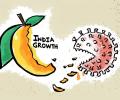
The International Monetary Fund (IMF) on Tuesday cut its economic growth forecast for India to 9.5 per cent for the fiscal year to March 31, 2022 as the onset of a severe second COVID-19 wave cut into recovery momentum. This forecast for 2021-22 is lower than the 12.5 per cent growth in GDP that IMF had projected in April before the second wave took a grip. For 2022-23, IMF expects economic growth of 8.5 per cent, larger than the 6.9 per cent it had projected in April.

Shimron Hetmyer's Rs 8.50 crore annual IPL fees earned from Rajasthan Royals or Andre Russell's Rs 16 crore retention fee from Kolkata Knight Riders is an indication how cricket's financial landscape has changed and playing for the West Indies isn't a motivation anymore.

Businesses are still taking time to adjust in the new tax regime, which would weigh on growth rates for the financial year closing today.

The previous high GDP growth of 8.1 per cent was recorded in April-June quarter of 2016-17.

The decline of over 5 per cent in PB Fintech's shares (the parent company of PolicyBazaar) in the past two days presents an opportunity for long-term investors to consider buying the stock, suggest analysts. By comparison, the benchmark S&P BSE Sensex has remained flat during the same period with a negligible gain of 40 points, or 0.06 per cent. Analysts believe that the recent selling is "overdone", as the company behind the online insurance portal remains committed to achieving profitability, and the potential threat from the government's online insurance portal, Bima Sugam, might be embellished.

A senior government functionary claimed on Thursday that the average estimated cost of MQ-9B long endurance drones for India would be 27 per cent lower than the price incurred by other countries which have bought it from the US, asserting that it will most likely go further down during negotiations unless India seeks additional features.

Net new enrolments with retirement fund body EPFO grew by nearly 20 per cent to 12.37 lakh in February compared to the same month in 2020, according to the payroll data released on Tuesday, providing a perspective on formal sector employment amid the coronavirus pandemic. The provisional payroll data of EPFO highlights a growing trend with the addition of 12.37 lakh net subscribers during the month of February, 2021, a Labour Ministry statement said. The data reflects growth of 3.52 per cent in net subscribers addition in February 2021 over January 2021.

'A very large part of this would have come from opium.'

'Nirmalaji's Budget announcements have long-term implications and are not backed by enough money when the short-term outlook looks bleak,' notes T N C Rajagopalan.
